Risky Tuesday #15 · Key-person risk · 10 November 2026 Every Tuesday, we take one risk event from somewhere in the world and classify it according to the Five Quadrants methodology. Honey, I Shrank the Market Cap Quadrant 2
Figure 1: Alice Huang (left) and Jensen Huang with her at a dinner (right). A US intelligence memo alleges China’s Ministry of State Security recruited her. She has not been charged. Images: Huang Xiao Le/LinkedIn and NOWNews, via Mothership. Dear Reader, There’s a video going round of Jensen Huang dancing on stage in a black T-shirt. Pretty awkward, pretty happy. This week the internet found the probable source of that joy. On 29 October the New York Times reported that US intelligence believed a Megaspeed executive, Alice Huang, was a Chinese intelligence asset who had grown close to Nvidia’s chief executive. Megaspeed is a Singapore cloud company and an Nvidia customer, already under investigation over whether it helped Nvidia chips reach China. On Friday 6 November, the NYT and the Financial Times reported on a memo written by US officials earlier this year. It alleges that China’s Ministry of State Security recruited her to gather information on Jensen Huang, and the FT reported that it describes a romantic relationship. Beijing called it "groundless speculation." Then on Sunday 8 November, Jensen emailed his staff and admitted the affair. "There is no excuse for what I did," he wrote. Nvidia’s board has opened an investigation led by independent directors and says it has no reason to believe any national security or Nvidia secrets were compromised. Nobody has been charged. The spying is still an allegation. The affair isn’t. On Monday, 9 November, Nvidia fell as much as 8% during the day and closed down 4.3%, while the Nasdaq rose almost 3%. About $190 billion of market value disappeared by Monday’s close. X had already reached its verdict, with posters convinced the AI bubble had been popped by one man’s private life. So, I went looking. How often does a boss’s affair actually sink the share price? And what kind of risk is it? The quadrant map at the end has the answer: Quadrant 2, a known hazard of unknown size.
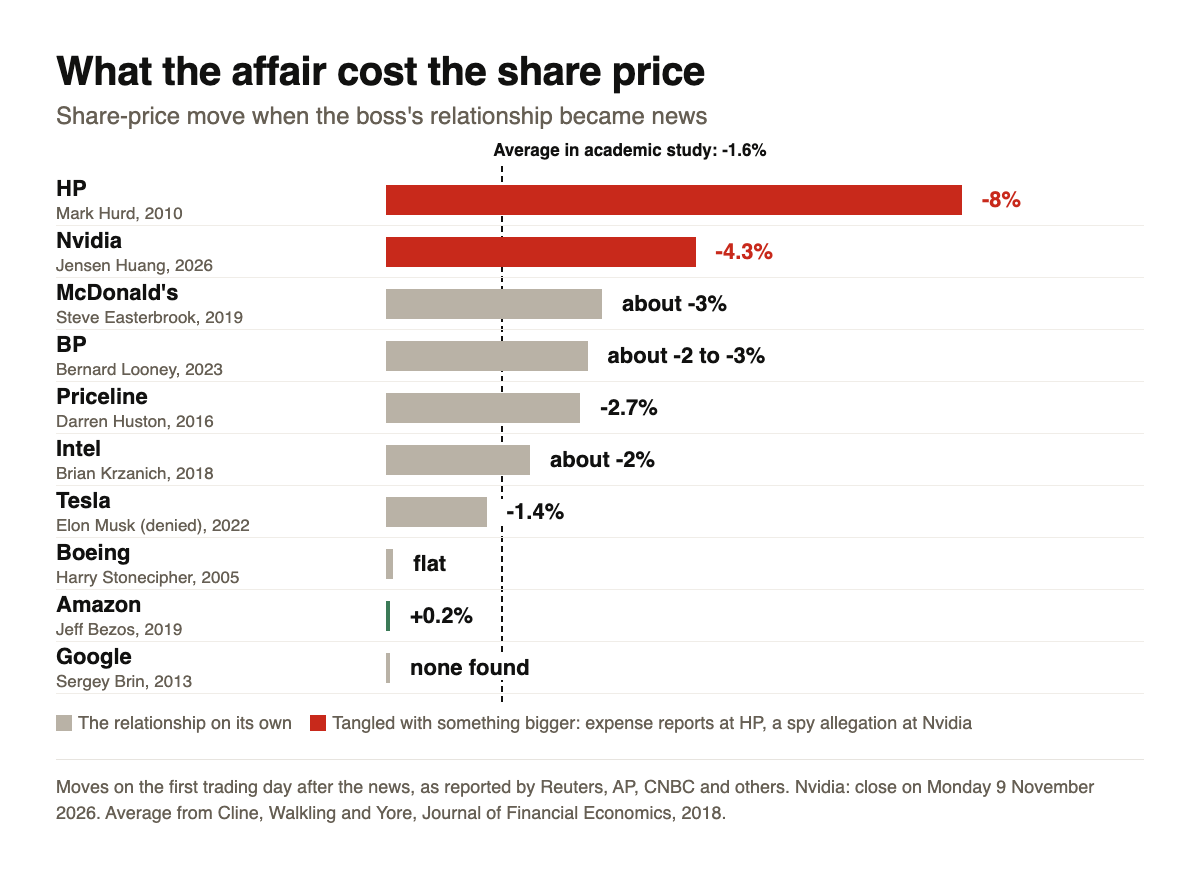
The Scoreboard Not very often, it turns out. When Jeff Bezos announced his divorce in January 2019, with the National Enquirer’s story about his new girlfriend out the next day, Amazon closed up 0.2%. When the settlement came through in April, it moved 0.1%. When Sergey Brin’s separation and his relationship with a Google Glass manager came out in 2013, I can’t find any move in Google’s shares at all. Elon Musk denied a 2022 report that he’d had a fling with Brin’s then-wife, and Tesla dipped 1.4%. The hired CEOs did worse, but not by much. Intel’s Brian Krzanich resigned over a past relationship with an employee in 2018: down about 2%. Priceline’s Darren Huston in 2016: down 2.7%. McDonald’s fired Steve Easterbrook in 2019: down about 3%. BP’s Bernard Looney quit in 2023 over relationships he hadn’t fully disclosed: down about 2 to 3%. Boeing pushed out Harry Stonecipher in 2005, and the shares barely moved.
Figure 2: Share-price move on the first trading day after the boss’s relationship became news. Academics have measured this. Cline, Walkling and Yore studied years of US cases of executives behaving badly in their private lives. The average share price drop on the news was about 1.6%. Founders tend to survive, but hired CEOs have had somewhat less luck.
The Real Cost The big drops have one thing in common. The affair was never the whole story. Mark Hurd left HP in 2010 after a contractor, Jodie Fisher, made a harassment claim. HP found no harassment, and both denied a sexual relationship. What finished him were inaccurate expense reports linked to their meetings. HP fell 8% the next day. The market will put up with a lot, but a cover-up is where it draws the line. And the lawyers have arrived. On Monday, shareholders filed a proposed class action accusing Nvidia and Huang of concealing the relationship and its potential national security implications.
Why This Case Is Different The bigger question is what Beijing might have learned or influenced. Nvidia makes the chips the US government has spent years trying to keep out of China. If the woman in the CEO’s life was working for China’s spy agency, as the memo alleges, the risk moves from the gossip pages to export licences, Congress and the company’s whole relationship with Washington. There is an important distinction here. Espionage seeks information, whereas influence tries to shape decisions. US intelligence reportedly suggested that Alice Huang’s role might extend to encouraging more favourable US chip-export policies. That would make access to Jensen Huang potentially valuable even if no company secrets were disclosed.
An Old Trick The honeytrap is a very old trick. Britain’s war minister, John Profumo, resigned in 1963 after an affair involving a woman who was also seeing a Soviet naval attaché. East Germany sent "Romeo" agents to seduce secretaries in Bonn for decades. China’s own security ministry warned its students in 2024 to watch out for "beautiful women" and "handsome guys" abroad. More recently, Christine Fang cultivated relationships with American politicians, including Congressman Eric Swalwell, and reportedly had romantic relationships with two mayors. The object of such operations need not be an envelope stuffed with secrets. The only new part is the market cap.
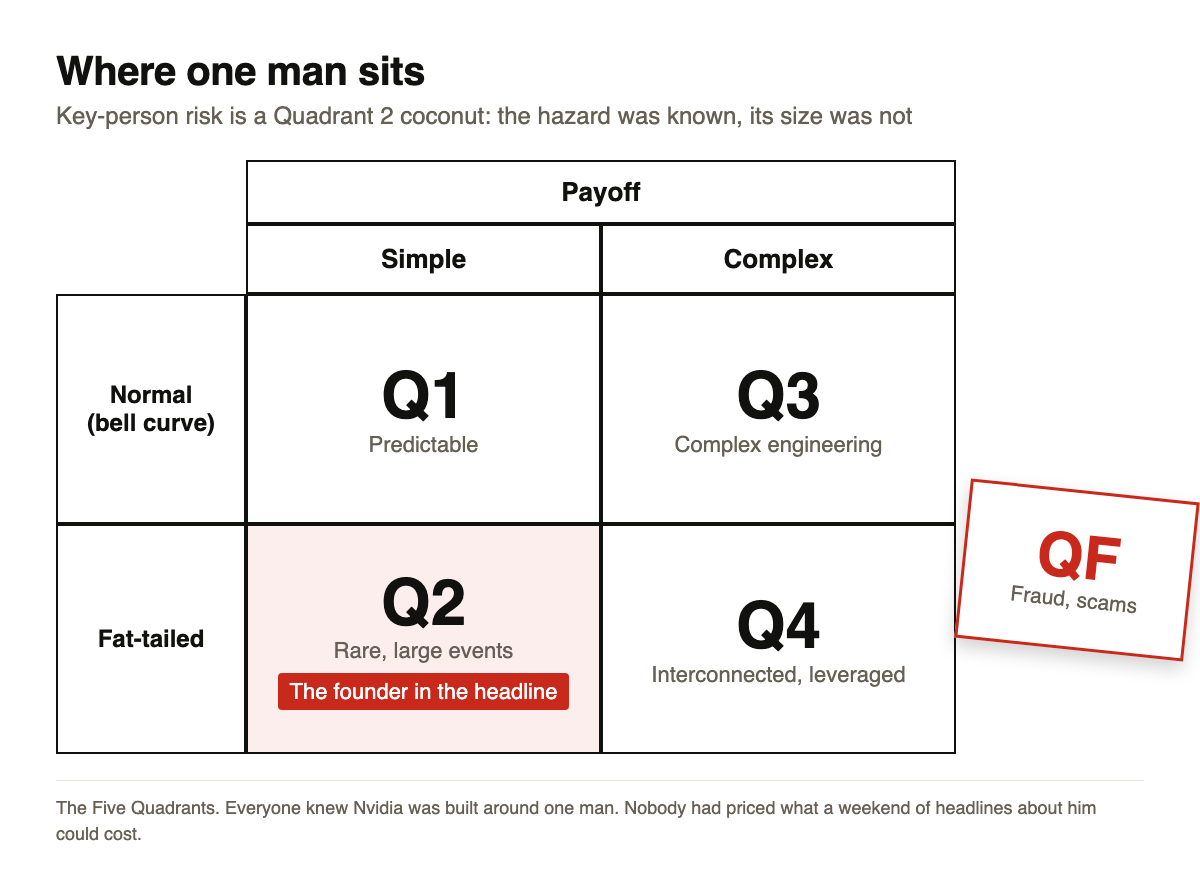
What Quadrant Is Key-Person Risk In? Quadrant 2, the Coconut. The hazard (key-person risk) was always known. Every analyst knows Nvidia is built around one founder in a leather jacket. What nobody could reasonably estimate was how far a personal scandal might spread, from the CEO’s private life to corporate governance, national security, export licences, and investor confidence. The affair may turn out to have compromised nothing, but the market can’t know that yet. Bernstein’s Stacy Rasgon called it "(so far) more form than substance, though a (very) bad look." Nvidia reports earnings on 17 November. The day after, Huang is due at a closed briefing with three House committee chairs. Both will tell us whether 4.3% was the bill or just the deposit.
Figure 3: The 5 Quadrants. Key-person risk sits in Quadrant 2: the hazard is known, but its size is not. Boards plan for the founder getting hit by a bus. Very few plan for the founder getting hit by a headline.
Now I Need You Does your board have a plan for the day the founder becomes the story? Tell us.
Joanna Reijgersberg-Siew & David Munro
|