Risky Tuesday #7 · 15 September 2026 Every Tuesday, we take one risk from somewhere in the world and classify it according to the Five Quadrants methodology. What If AI Works? Quadrant 4 – where models die
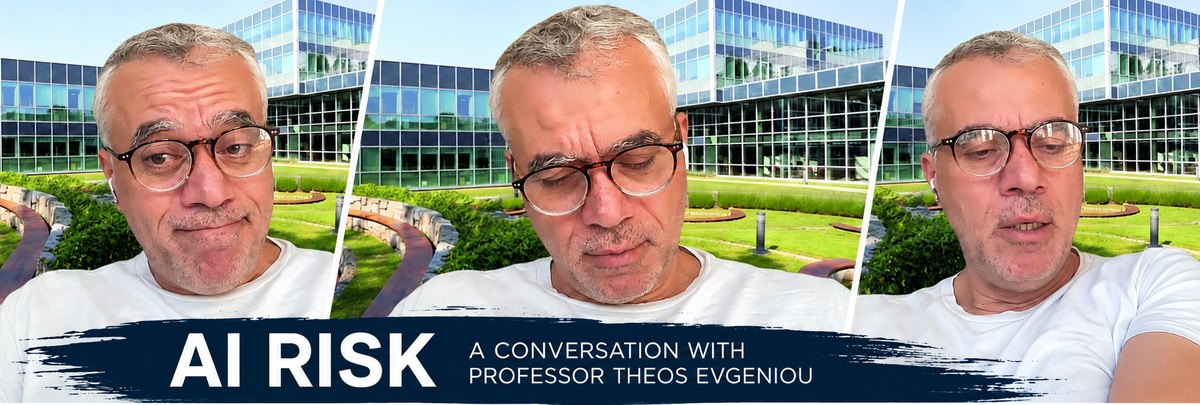
This week is slightly different. We listened to your questions and the risks you asked us to address, and AI came up repeatedly. Some of you worry about the models themselves, others about jobs, control, concentration, regulation or what happens when AI becomes better at things we thought were uniquely human. So we went as close to the source as we could. Theos Evgeniou is Professor of Technology and Business at INSEAD and has worked on machine learning and AI for 30 years, long before ChatGPT turned the subject into dinner-table conversation. He also has four degrees from MIT, including Mathematics and a PhD in Computer Science, which made him a useful person to confront with some of the questions you sent us. Theos processes ideas and speaks at a rapid-fire clip, as if he physically needs to expel one clever thought to make room for the next, so interviewing him was an exercise in keeping up. We had a long conversation and will publish it in several parts. The questions provide the interview structure, Theos's answers remain at the centre, and after each discussion we return to our usual Risky Tuesday question: what is the actual exposure, and where does it sit in the Five Quadrants?
Question 1: What happens when AI can solve something humans cannot? We started with mathematics. A conjecture dating from 1946 had recently been disproved by AI, and it took nine mathematicians to translate the machine’s proof into something humans could read and check. That’s the sort of headline designed to make humans nervous, so we asked Theos whether it concerned him. It did not, at least not for the obvious reason. His starting point is that we should stop assuming machine intelligence ought to resemble our own. “There are reasons to expect that the type of intelligence that AI has … is not the same as the type of intelligence we have.” Humans and machines have different architectures, learn differently and are likely to remain good at different things. AI can therefore perform extraordinarily well on some things humans find almost impossibly difficult and then make a mistake that looks embarrassingly simple to us. Researchers sometimes call this the jagged frontier of AI capabilities. An AI-generated proof raises a separate question: Who checks it? Theos highlights that verification is an easier problem than generation of a solution and points to emerging agentic systems in which one AI produces a result and another checks it. A machine doing mathematics differently from a human is therefore interesting, but for him it is only part of the bigger story that deserves our attention. The bigger claim, though, was about something other than mathematics: “This is not about AI. This is about a new scientific revolution supported by AI.” Most of what we currently call AI remains digital and visible through chatbots, copilots, search, coding and now agents. Theos expects the larger change when AI becomes a co-scientist across chemistry, materials science and physics, and then moves further into robotics, manufacturing and the physical world. “That’s the real deal, and we haven’t started that yet.”
Where does that sit in the Five Quadrants? The first task of the Five Quadrants is to define the risk before classifying it. An AI solving a mathematics problem is not, by itself, a risk and does not belong in Q4 simply because the technology is unfamiliar. A scientist may see it as a powerful new tool. For a company or country, the exposure changes once AI begins accelerating discovery across multiple fields and feeding those advances back into technology, capital investment and competitive advantage. At that point interconnectedness rises sharply, and the distribution of outcomes becomes much harder to estimate. Scientific advances feed into chips, energy, medicine, manufacturing and defence, and those advances alter investment and productivity. The winners then plough resources back into the next round of innovation. The systemic version of that exposure begins to look like Q4, but the important point is the mechanism rather than the label. The risk comes from the connections and the possibility that the consequences compound.
Question 2: When does AI risk become systemic? Several readers have raised a related question: when people say AI risk could become systemic, what does that actually mean? What should a board or a country do differently on Monday morning if it believes that? Theos's answer had very little to do with a rogue machine. “I have a very non-AI view about the systemic use of AI … it relates to the impact of AI on inequality between people, but also between nations.” His concern is not simply whether AI becomes more capable, but whether individuals, companies and countries adopt those capabilities at radically different speeds. Imagine two companies starting from roughly the same position. One reorganises workflows around AI, learns quickly, attracts people who know how to use it and reinvests the resulting productivity gains. The other adds a chatbot or two and waits for a clearer ROI case. If AI delivers meaningful gains, the distance between them does not necessarily remain constant. The first company may improve faster precisely because it is already ahead. The same logic can apply to workers, industries and countries. This is where Theos sees the systemic risk. “A combination of wrong policies and fast AI adoption inequality and fast AI innovation inequality can create systemic risk because of economic and socio-economic reasons, not because of technological reasons.” Productivity diverges, capital follows the winners, skills are repriced and eventually, technological capability just becomes economic power. As he put it, “That’s the systemic risk, which is because of these inequalities. I think that’s the biggest risk by far.” Much of the AI-risk debate starts with failure: hallucinations, cyberattacks, autonomous systems behaving badly or, at the extreme, AI escaping human control. Theos is pointing to another possibility. AI can function exactly as intended and still create serious risk if the benefits and capabilities accumulate unevenly. Success, distributed badly, can be destabilising.
The Quadrant 4 problem From a Five Quadrants perspective, the systemic exposure Theos describes is much more clearly Q4. The relevant risk is no longer one company choosing the wrong software or one worker failing to acquire a skill. Thousands of individual adoption decisions become connected through labour markets, capital flows, supply chains, national policy and geopolitics. The possible outcomes are also fat-tailed or simply difficult to know in advance. A small initial difference in adoption can become a much larger difference in economic capability. Q4 risks are not managed by pretending we can forecast the precise outcome. The objective is to reduce dangerous dependencies and avoid excessive exposure to one path. Where possible, preserve options and liquidity, and move pieces of the problem into quadrants that are easier to manage. For a board, that includes the risk of moving too slowly. Theos reduced the issue to a practical question: “How fast are you moving to ensure that you are not left behind and the people are not left behind?” He described the possibility of a hockey-stick pattern, with a relatively small number of companies, people or countries moving rapidly up the curve while everyone else remains near the bottom. A company can congratulate itself for adopting AI faster than its traditional peers and still be falling behind the organisations setting the pace. Hence another of Theos's questions to boards: “Are you on the high end of the hockey stick as a company?” Boards are rightly spending time on the risks created by adopting AI. The conversation with Theos suggests that the risk register also needs the opposite question: what happens to us, our people and our competitive position if AI works extremely well and others learn to use it faster than we do?
Now I need you This series exists because you send us risks and questions, so keep them coming. Where do you see the biggest AI risk in your business? Are you more concerned about moving too quickly or being left behind? And if you disagree with Theos that inequality between adopters and non-adopters could become a major systemic AI risk, tell us what you think we should be worrying about instead.
Next Tuesday, we continue our conversation with Theos Evgeniou and look at another AI risk through the Five Quadrants. Forward this to someone who would argue with it. Claudia and Dave NOTE: In the spirit of the topic: AI wrote the first draft. The humans supervised, rephrased, and tightened the verbiage. Interview was held in person.
|