Risky Tuesday #6 · 8 September 2026 Every Tuesday, we take one risk event from somewhere in the world and classify it according to the Five Quadrants methodology. This is the sixth. Wine Fraud Quadrant F – the domain of frauds, scams and Ponzi schemes
La Nez Wild, with loads of perfumed spice, big red fruits and earth; enrapturing, with notes of French toast, crème brûlée, cocoa bean, chocolate ganache, morello cherry and aged mahogany. Not a smoothie, not a dessert, but a 100-point Domaine Ponsot Clos de la Roche Cuvée Vieilles Vignes. Rudy Kurniawan arrived in the US on a student visa in the late 1990s and quickly developed a reputation as one of the world’s preeminent connoisseurs of French Burgundy. Though his background was a mystery—most thought he was a trust-fund kid—he spent millions per month on rare wines, hosted lavish tastings for Hollywood elites and Wall Street billionaires, and gained the nickname “Dr Conti” for his obsession with Domaine de la Romanée-Conti. His accuracy at blind tastings was unrivalled. “Any wine, from California to France, any type of wine, any vintage. Rudy was extremely, insanely, unbelievably correct on all the wines.”
A Talented Artist Kurniawan was considered an organoleptic genius, able to deconstruct a wine entirely through his senses. He also had a nose for counterfeit bottles. Appropriately enough, Kurniawan was the counterfeiter, concocting believable matches to original vintages by blending fresher California Pinot Noirs with older, faded burgundies. He completed the packaging with counterfeit labels, corks, capsules, bottles, and sediment.
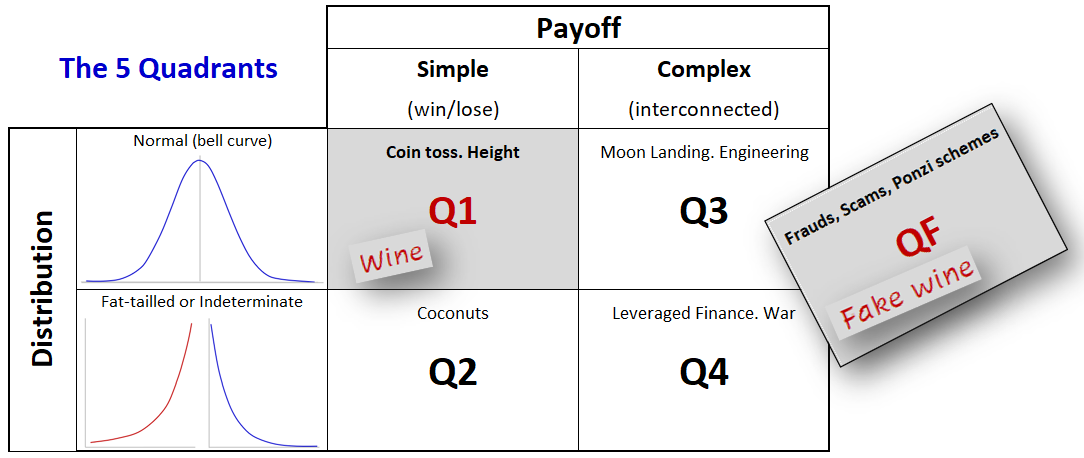
Quadrant Quandary Buying and drinking wine is a simple quadrant 1 risk. The price is known, the quality is rarely a surprise, and the odd corked bottle is part of a normal distribution. (Consume a few too many bottles and one could easily land in Q4, where models don’t work, but let’s ignore the risk of inebriation). With expensive vintage bottles, Quadrant 2 (fat tails) is the reflex answer, but risk is relative. A $15,000 bottle bought by someone for whom $15,000 is immaterial remains a small, predictable loss. Still Q1. What happens if you are billionaire collector Bill Koch and estimate that you have purchased over $4 million of counterfeit wine? You hire an investigator and discover that the 1921 magnum of Petrus in your collection was never bottled, at least not by Petrus. You can likely handle the financial loss, but the emotional cost will be high. Koch believed that the vintner’s caress could be tasted in the wine and that it was almost a religious experience. At that level, wine fraud is unquestionably Quadrant F. Wine fraud is not new. Pliny the Elder (AD 23/24-79) supposedly complained about the abundance of fraudulent Roman wine. The 2016 documentary about Kurniawan's rise and fall Sour Grapes (Jerry Rothwell & Ruben Atlas), estimated that 10,000 bottles of his fake wine remain in private collections.
Figure 1: A single bottle of wine is a simple and normally distributed Quadrant one risk. One corked or counterfeit bottle—even a case—won’t kill you. 10,000 fake bottles, selling for many millions of dollars, shifts the risk to quadrant F.
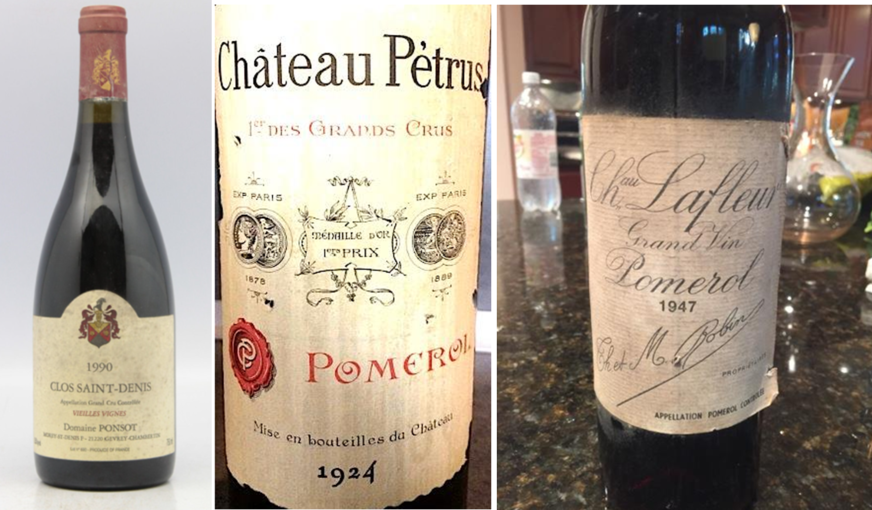
Caught Burgundy-handed John Kapon was a third-generation wine merchant whose family owned the boutique shop Acker Merrall & Condit. He became Rudy’s primary auctioneer and, in 2006, hosted two record-breaking auctions devoted entirely to Kurniawan’s personal wine collection. Kurniawan’s wines, which sold for more than $35 million, included eight magnums of 1947 Château Lafleur. Inconveniently, in 2007, a former head of Sotheby’s wine department revealed that only five magnums of the Château Lafleur were produced in 1947. Math, especially addition, can be perplexing for an artist.
Figure 2: Images of a 1990 Ponsot Clos Saint-Denis, a 1924 Petrus, and a 1947 Lafleur, all labels that featured prominently in Rudy Kurniawan’s wine scam. Photos courtesy of Vins & Millésimes and Cellar Tracker. Laurent Ponsot, head of Domaine Ponsot, provided the next clue. Ponsot waxed poetically about the wines he grew up with in Morey-Saint-Denis, saying that you could feel the spirit of the vines and that the name on a label represented not just a wine, but a culture and a history. When the April 2008 Acker auction catalogue arrived, Ponsot naturally flipped to the Domaine Ponsot page and saw a 1929 Clos de la Roche. Domaine Ponsot didn’t begin estate bottling until 1934. That discovery affronted his wine spirit, so he hopped on the next plane to attend the auction. Kurniawan had also offered Ponsot Clos Saint-Denis from vintages decades before the estate acquired the vineyard rights in 1982. While Kapon was at the podium and about to start the auction, Ponsot halted the auction by shouting, “Withdraw my wines.”
Behind Bars In 2012, FBI agents raided Kurniawan’s suburban LA home and discovered a literal “crime kitchen”: thousands of fake labels, corks, stamps, blending recipes, and old bottles ready to be refilled. He was sentenced to ten years in prison in 2014, released in November 2020 and deported.
A victimless crime? Many connoisseurs apparently enjoyed Kurniawan’s counterfeit blends. Few realised or admitted that they had been duped. In fact, sometimes fresher Pinot Noirs even improved the drinking experience. If the fakes taste as good as, or better than, the original, who suffers? The real cost wasn’t financial or even gustatory; it was the embarrassment of a connoisseur unable to spot a fake. Kurniawan had exploited the vanity, wealth, and FOMO of the ultra-rich, who often cared more about the prestige of drinking a rare bottle than the wine itself.
The Sequel A French restaurateur in Singapore told me a couple of years ago that Rudy had been seen dining at top restaurants and taking the empty bottles home with him as mementos of the evening. Normally, I wouldn’t bat an eyelid… More recently, Rudy has reportedly been operating as an “outlaw celebrity” blender in Singapore, hosting private dinner parties. Wealthy patrons commission Rudy to use his legendary blending palate to recreate multi-thousand-dollar bottles such as a 1990 DRC Romanée-Conti or a 1982 Château Cheval Blanc. His “remix” is then served blind alongside a genuine bottle of the same vintage. In multiple recorded events, elite tasters actually preferred Rudy’s fake over the genuine bottle. Wine snobbery has been turned on its head. What was a scam a decade ago has become an interactive party trick for bored billionaires. It sounds like a business opportunity: Rudys Ruby Redos. By coincidence rather than, as far as anyone knows, collaboration, John Kapon formally launched Acker Wine Merchant in Singapore in January 2026. While there is absolutely no evidence that these two have renewed their business relationship, both operating in Singapore and selling/blending/auctioning similar trophy vintages is peak dark comedy. At places like Wakuda in Marina Bay Sands, ultra-high-net-worth collectors sit with Acker and bid on pristine, authenticated, vintage Burgundy and Bordeaux. Just blocks away in private clubs, some of the same clientele reportedly pay Rudy to drink fake versions of similar vintages. It looks like the ultra-rich have moved past the fear of being conned and are now actively paying the con artist for the thrill of the con itself.
Figure 3: A price comparison of vintage wines, and the base cost to replicate those wines. Sources strictly confidential.
Now I need you This project only works if we have a conversation. Have you ever discovered a high-priced counterfeit Bordeaux in your cellar? How did you realise it was a fake? Did you take any action, drink it, or regift it to someone you don’t much like? Better yet, have you secured a seat at a Rudy blend party and found a new favourite mélange? Let us know your oenological opinion and especially what you would disagree with in this Risky Tuesday newsletter. We’ll collect the best and share them in a future issue (or on the website risk repository), with credit.
Next Tuesday, a different risk and a different quadrant. Forward this to someone who would argue with it. Dave
|