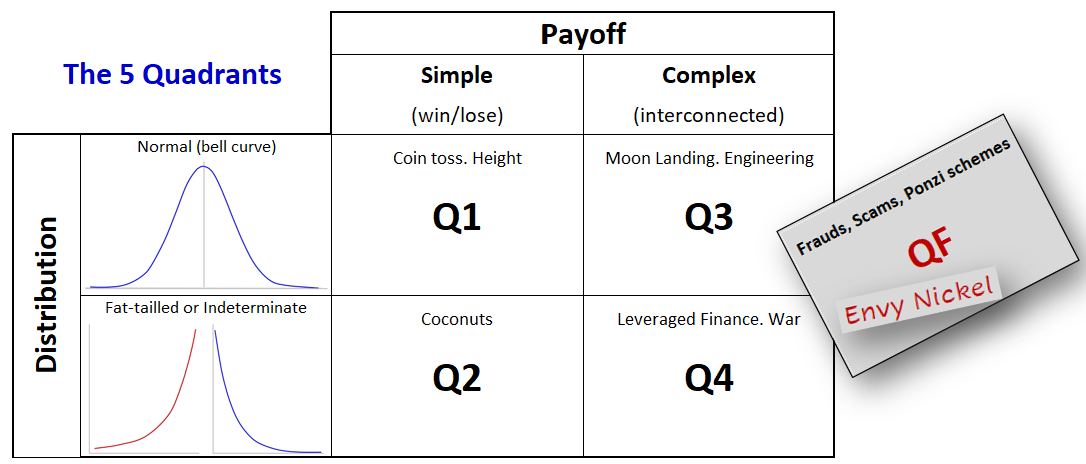
Risky Tuesday #5 · 1 September 2026 Every Tuesday, we take one risk event from somewhere in the world and classify it according to the Five Quadrants methodology. This is the fifth. The Great Nickel Illusion Quadrant F – the domain of frauds, scams and Ponzi schemes
The Bait Envy Global Trading raised SGD 1.46 billion ($1.1 billion) in investor capital between 2016 and 2021 to purchase physical and forward nickel contracts at a discount. The nickel would then be sold to major institutions, such as BNP Paribas, at market prices. The difference, less a fee, amounting to 15% every three months, would accrue to the investors (that’s equivalent to a compound annual 75%). Sound too good to be true? Of course it was. Yet many fell for it, and they certainly weren’t the first on record to covet too much of a good thing: Rosalind, in William Shakespeare’s play As You Like It, asked circa 1600, “Can one desire too much of a good thing?” In the 1933 film I’m No Angel, Mae West similarly said, “Too much of a good thing can be wonderful!” Too much yield from commodity arbitrage is a red flag.
The Switch Ng Yu Zhi, the protagonist in this tragi-comic tale, started his career as a junior auditor for KPMG. That role likely gave him enough detailed technical knowledge about corporate structures, trade finance, and shipping documentation to later forge invoices, contracts, and bank statements. He didn’t have any trading desk experience with global commodity trading firms, though he did claim to have uncovered a “niche, discounted” loophole to buy and sell physical nickel. Ng kept the scheme alive with forged agreements and trading documents, investor rollovers, referral fees and transfers among related entities. Investors could redeem every three months. Some did, with new investor money funding the redemptions (the classic Ponzi mechanism), but most rolled their money over and encouraged friends and associates to join. Instead of independently verifying the nickel, counterparties and cash flows, investors depended exclusively on Envy and its network to validate the critical facts. It wasn’t long before Ng owned a rare Pagani Huayra, a Rolls-Royce Phantom (an excellent name for our non-physical nickel apparition), two Lamborghinis, high-end property, Dali and Botero artwork, jewellery, and a diamond-encrusted Audemars Piguet. Private jets, a butler, a chauffeur, fine dining and nightclubs followed. Too much of a good thing, indeed.
Figure 1: Ng Yu Zhi, the “mastermind” of the Envy nickel scam, spent more than S$21 million on luxury cars. Jewellery, watches, real estate, and art were all probable money laundering tools. Photo from Lianhe Zaobao file. Prosecutors allege that about S$482 million was channelled from Envy to Ng’s personal bank accounts. Of that, over S$200 million was withdrawn, and another S$94 million was laundered through luxury assets (these remain allegations since the criminal case is unresolved). Ng is currently in the clinker awaiting sentencing for 42 charges that include cheating, forgery, fraudulent trading, money laundering, and criminal breach of trust. “We are not stupid people.”1 Indeed, they were not. In fact, many of the 947 investors in Envy Global Trading, via the Envysion Commodity Strategy Fund, were well-educated, influential, and professionally accomplished. They included a former president of the Singapore Law Society, the General Counsel of a major sovereign investment company, a venture capital fund chairman, the CEO of a listed holding company, a criminal defence lawyer, boutique wealth funds, and wealthy entrepreneurs. The South China Morning Post said the case was notable “for how some of the city-state’s brightest and most influential figures have purportedly fallen prey to the scam.”2 How did so many otherwise accomplished individuals get duped by a commodity investment scam? It had nothing to do with their intelligence and everything to do with deceptive Quadrant F, the domain of frauds, scams, and Ponzi schemes.
A Criminal Mind Quadrant F risks are different from ordinary investment risks. This is where criminal elements try to steal your money, possessions, identity, data, reputation, or future. In Quadrants 1 through 4, you generally expect investments to perform. In QF you’re asking whether the investment, assets and counterparties exist at all. Piggybacking on the due diligence of others is therefore dangerous. The main goal in QF is to avoid being robbed. For this, one must think like a criminal. Sherlock Holmes admitted that his brain operated like a master criminal’s and that he chose the side of the law purely to avoid boredom. Frank Abagnale (inspiration for the movie Catch Me If You Can, starring Leonardo DiCaprio) was a real-life fraudster hired by the FBI to teach them how to prevent fraud. Patrick Jane, played by Simon Baker in The Mentalist, was similarly a police consultant who used human greed, distraction, and psychological manipulation to catch fraudsters in their lies.
Figure 2: Sherlock Holmes, played by Jeremy Brett in 41 episodes from 1984 to 1994, image from tvinsider.com. Leonardo DiCaprio is depicted as Frank Abagnale in an image from Amazon, and Simon Baker as the Mentalist in an image from GOLDENDISCS.
The Setup The nickel was to be purchased from Poseidon Nickel, an Australian development and exploration company. A quick Google search would have revealed something awkward. Poseidon had never produced or sold an ounce of physical nickel. It was an exploration company hoping to begin production in 2022, subject to establishing that its mines were viable. They never were. Not one shovel of dirt was turned. Early fraud detection was but a Google away. Ng told investors that he was selling the Poseidon nickel at a profit to companies such as BNP Paribas Commodity Futures Limited. Envy forged dozens of LME trading statements and consolidated financial documents purportedly issued by BNP Paribas that showed “real” nickel briquette transactions. The reality was different. BNP Paribas had no account, trading history, or business relationship with Ng or any of the Envy entities. Not only was BNP Paribas Commodity Futures Limited not involved in nickel trading at the time, but it also officially ceased operations in March 2019. The seller had no product, and the buyer didn’t exist.
Which Quadrant Hosts Commodity Trading? Does non-fraudulent commodity trading belong in Quadrant 1 (simple product and a normal distribution) or Quadrant 2 (still simple, but fat-tailed outcomes)? When the price of oil can go negative, the prices of cocoa and lithium can rise close to infinity, and when trades can be cancelled and the rules changed, you’re in Q2.
Figure 3: Ng Yu Zhi and his Envy Nickel group didn’t even get close to any of the four traditional risk quadrants. Fraudsters often start off with a legitimate Q1 or Q2 business and, via a destructive “one-thing-leads-to-another” spiral, fall into QF. NG started and ended in QF. Fraud was the intention from the start.
The Jig Was Up Singapore banks had begun filing suspicious transaction reports and closing Ng-linked accounts as early as 2019. Envy responded with a “corporate restructuring,” shifting operations from Envy Asset Management to Envy Global Trading in June 2020. The manoeuvre bought time, but not much. Ng was arrested in February 2021; bank accounts were frozen and luxury assets seized.
Commodity Trading Reality Risk-free commodity returns are a myth. Nickel prices fluctuate second-by-second on global exchanges. I traded LME nickel futures and OTC options in a quant fund and likely discoloured a few hairs in the process. Counterparty risk is real. Either the mine fails to produce the grade required, or the broker defaults on payment. Shipping delays, port strikes, and weather anomalies regularly disrupt bulk freight. Court records indicated that Ng tracked fictitious Australian hurricanes to explain fake shipping delays to investors. Give the guy full marks for imagination. Extraordinary arbitrage attracts extraordinary competition. If nickel routinely offered 15% quarterly returns, Glencore, Trafigura, global banks and sovereign wealth funds would deploy enormous amounts of capital to capture them. Nor would a legitimate trader pay retail investors 15% every three months when bank funding was available at a tiny fraction of that cost. Physical commodity trading can be profitable, but margins are generally thin: mines do not routinely sell nickel at deep structural discounts to unknown middlemen, and institutional buyers have little reason to pay those middlemen enormous premiums when they can source directly.
Fraud Screener Checklist
Conclusion In investing, envy may be dangerous. But the more useful emotion is disbelief, particularly when someone offers 15% every three months for buying nickel that nobody has produced and selling it to a buyer who does not exist.
1 Shim Wai Han, former CEO of Envysion Wealth Management, who testified as a victim while also facing separate charges over risk-management failures at her firm.
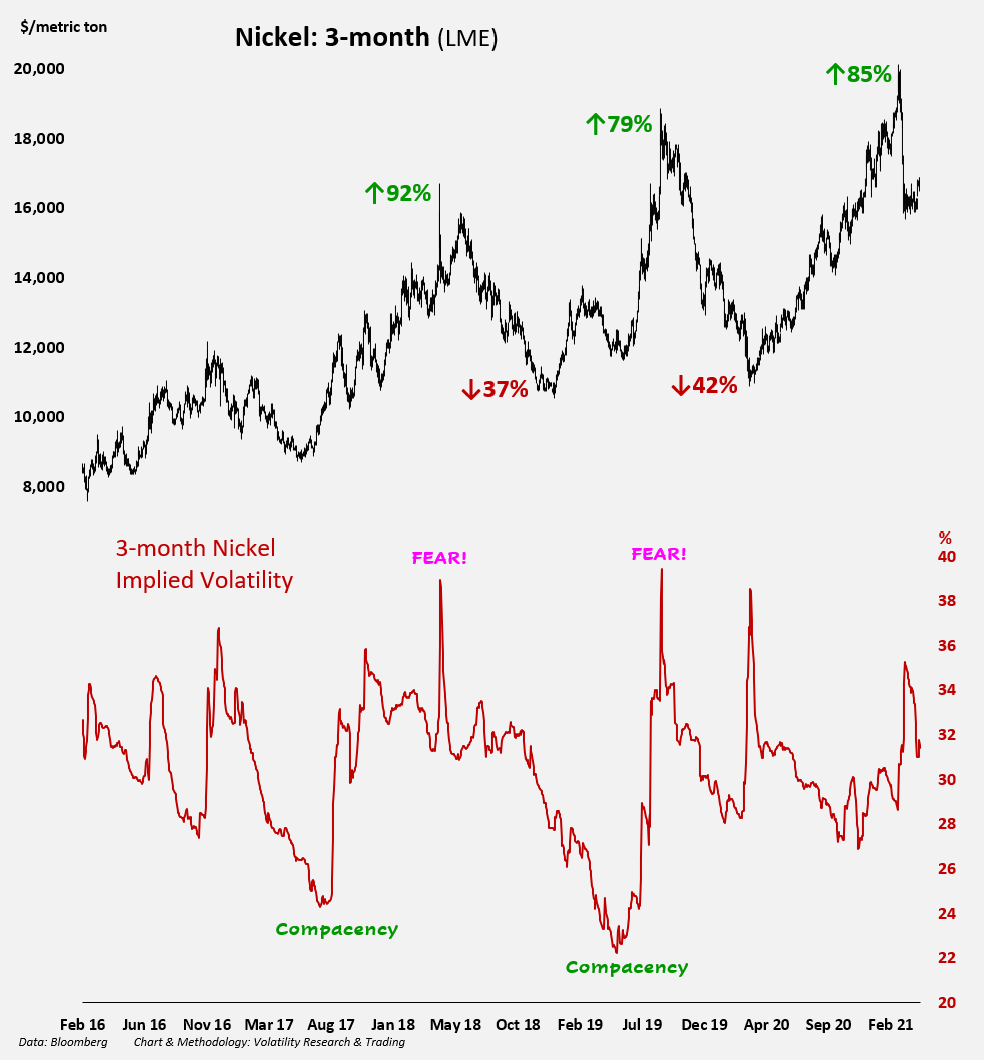
Appendix – The Reality of Nickel Trading The following chart, showing the price per metric tonne of 3-month LME nickel and 3-month nickel implied volatility, tells us that nickel is a volatile commodity. In a span of under four years, prices rose 92%, fell 37%, rose 79%, fell 42%, and rose 85%. And those were calm and orderly nickel markets.
Figure 4: Nickel, 3-month LME price per metric tonne and 3-month implied volatility, February 2016 to February 2021. Data: Bloomberg. Chart & methodology: Volatility Research & Trading. Had Envy Nickel’s ploy not been uncovered in March 2021, the jig would have been up exactly one year later when nickel prices air-pocketed to over $100,000 per metric tonne. The $25,000/MT price was already at a 10-year high when Russia invaded Ukraine on 24 Feb 2022. Russia then supplied about 15% of the world’s high-grade purity Class 1 nickel used in EV batteries. Panic over potential sanctions and shipping blockades caused the 3-month benchmark price to soar fourfold to over $100,000/MT less than two weeks later. China had its own “Big Short” at that moment. Tsingshan, a large Chinese stainless steel and nickel producer, had built up a massive short position of an estimated 100,000 to 200,000 tonnes on the LME. Through their Indonesian nickel mines, Tsingshan was naturally long (meaning they owned) nickel. The LME shorts were considered a partial hedge against the Indonesian ore in the ground. But because Tsingshan’s mines produced low-purity nickel and the LME only accepted delivery of high-purity class 1 nickel, the hedge was merely “approximate,” As long as prices remained range-bound and no deliveries to the exchange were needed, the low-purity longs would do a reasonable job of hedging the high-purity shorts. As prices initially rose due to the war, Tsingshan had to pay increasing large sums to their bankers and brokers to satisfy margin calls and hold on to their shorts. When the short squeeze became unbearable, Tsingshan threw in the towel and tried to repurchase their shorts. Their aggressive buying, combined with speculators capitalising on the panic, sent prices parabolic in just days. By the early morning of March 8th, nickel prices went vertical, briefly skyrocketing past an unprecedented $101,000/MT. The system couldn’t handle this price tag, and regulatory panic set in. Several LME members faced bankruptcy as they struggled to pay billions of dollars in margin calls. The LME halted all nickel trading, cancelled $12 billion of trades, and rolled back prices to the closing level of March 7 (around $48,000). Traders—especially those who navigated the panic well—were understandably angry with the trade cancellations and scrambled to exit their positions, as prices gapped lower for several days. It is unlikely that Envy Nickel could have continued their ruse when nickel trading ground to a halt—every counterparty in the business would have faced solvency checks, and Ng had no real counterparties to check. Tsingshan, playing in Q2, nearly went bankrupt owning actual nickel mines. Ng, who owned none, would have had nothing to margin, nothing to hedge, and nothing to sell. A QF player would never have survived a market that violent.
Now I need you. This project only works if we have a conversation. Have you ever worked in a physical commodity trading, shipping, financing or insurance business? How frequently was fraud detected from your traditional due diligence checks? Do you have additions to the Fraud checklist that may help investors avoid future Envy-like dupes? Let us know your industry opinion and especially what you would disagree with in this Risky Tuesday newsletter. We’ll collect the best and share them in a future issue (or on the website risk repository), with credit. Next Tuesday, a different risk and a different quadrant. Forward this to someone who would argue with it. Dave
Risky Tuesday is written by Claudia Zeisberger and David Munro. |