 Risky Tuesday #3 · 18 August 2026 Every Tuesday, we take one risk event from somewhere in the world and classify it according to the Five Quadrants methodology. This is the third. Stuck in the Mud
The first human landing on the moon in 1969 was clearly a complex undertaking. It required the interaction of gravity, orbital mechanics, Earth’s rotation, pressure, oxygen, propulsion, electrical systems, and countless other moving parts. Computing power was primitive by today’s standards, yet the landing was precise and without incident. A classic Quadrant 3 engineering risk.
Engineering or Geopolitical Risks? Narrow waterways can fall into the same category when the main dangers are navigation, infrastructure, weather, mechanical failure, or congestion. The Suez and Panama canals and the Bosphorus Strait all require Q3 solutions: better engineering, greater redundancy, stronger operating procedures, and faster recovery post-incidents. Other chokepoints present a different class of risk. Ships passing through the Straits of Hormuz, Bab el-Mandeb, and Malacca may face military action, piracy, sanctions, or deliberate disruptions. These are Quadrant 4 risks, where engineering doesn’t help.
Clear Sailing for 151 Years The Suez Canal was a solution to supply chain problems in 1869. Completed after 10 years of construction, it drastically shortened the maritime trade route from Asia to Europe by eliminating the need to sail around the southern tip of Africa. It wasn’t an immediate engineering success. During the first 15 years, nearly 3,000 ships ran aground or became stranded because the channel was too narrow and shallow, yet it never closed. With successive improvements, the canal has operated for 151 years without a ship blockage closing it for more than a few hours. That is a fantastic engineering track record. But ships grew larger and larger while the canal remained the same size.
The Canal Needs More Fiber In March 2021, the Ever Given, a 400 m-long container ship (longer than the Empire State Building is high, but not longer than the reflecting pool 😊), became wedged across a narrow section of the Suez Canal, with its bow in Asia and its stern in Africa. It remained stuck for six days, blocking more than 370 ships and carrying an estimated $70 billion of cargo. It ultimately triggered penalties and claims by the Suez Canal Authority of over 500 million dollars. The initial explanation focused on 40-knot wind gusts and poor visibility due to a sandstorm, but further investigation revealed a more complex chain of events involving speed, navigation, bridge communication, and the absence of tug assistance. Reports observed that as the ship veered towards the sandbank, it appeared to speed up—perhaps in an attempt to correct itself—yet the action was too late and only served to wedge the steel hull more deeply into the side of the canal. This was a classic Q3 failure: a complex system without enough margin for error. Panama had already added a second canal lane between 2006 and 2016. Suez had fewer redundancies. Wider channels, stronger banks (concrete instead of sand), and greater tug capacity would all have reduced the likelihood of future Suez groundings. Redundancy is expensive, but so is six days of marine constipation.
Engineering Solutions Q3 risks are managed by multiple R’s that include Redundancy, Robustness, Reliability, Resourcefulness, Rapid Response, and Regulation. Suez authorities responded with nearly every R at once. Redundancy came from lengthening the parallel southern lane by 10 kilometers and adding tug capacity. Robustness came from widening and deepening the southern sector and expanding dredging capability. Reliability came from enhanced pilot training, digital ship monitoring, and better weather prediction. Regulation came from stronger operating rules and faster access protocols. 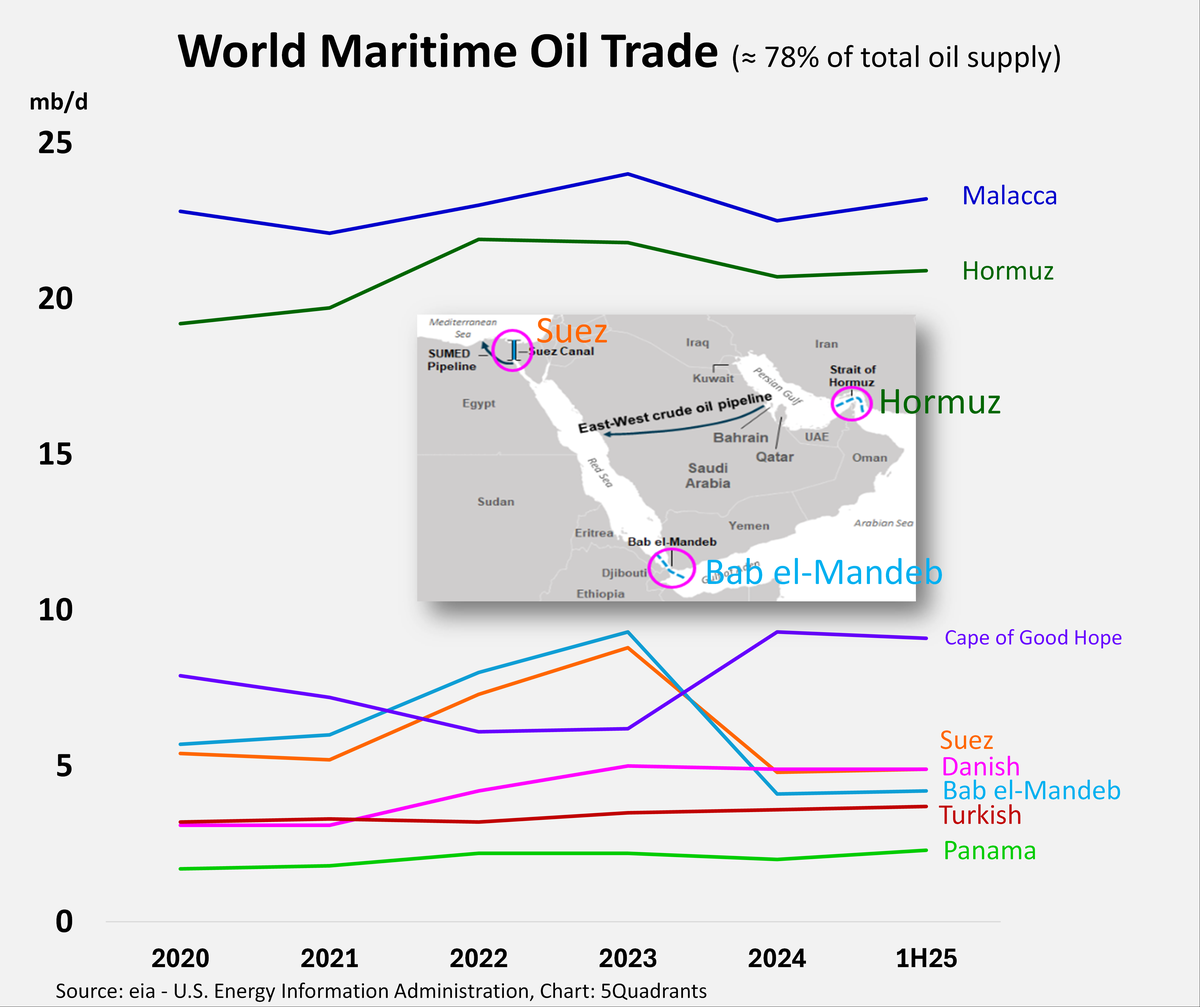 Figure 1: The volume of crude oil and petroleum liquids (million barrels per day) transported through world chokepoints (and the Cape of Good Hope) from 2020 to H1 2025 (annualized). Data and images from the U.S. Energy Information Administration. Chart by 5Quadrants.
The Houthi Risk In 2023, the Suez Canal remained physically open, yet traffic collapsed when Houthi forces attacked more than 100 vessels near Bab el-Mandeb, a narrow 26 km strait that divides Yemen from Djibouti/Eritrea. The chart above shows Suez oil traffic dropping by 5 mb/d from 2023 to 2025 and the amount of oil transported around Southern Africa’s Cape rising by an equivalent amount. Suez traffic halved from 26,400 ships in 2023 to 13,200 in 2024. The Suez Canal remained open (Q3), but the Bab el-Mandeb attack risk (Q4) defined the solution, which was simply avoidance. 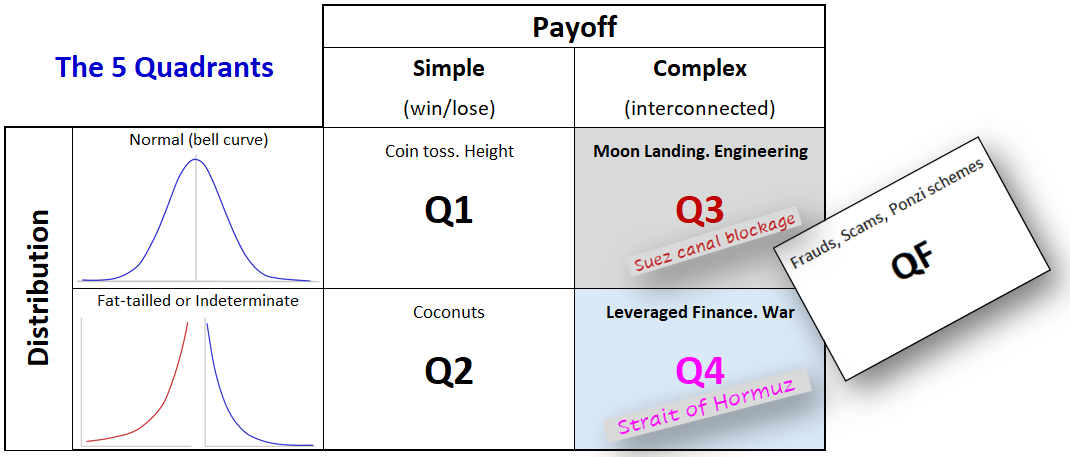 Figure 2: Narrow waterway risks reside in Q3 when engineering is the key and slip into Q4 when military action enters the picture.
Hormuz Gets Complicated. It’s Certainly Not Straight – and Quadrants shift The Strait of Hormuz is a more complicated chokepoint. In 2025, about 26% of maritime oil trade, equivalent to roughly 20% of total world oil supply, passed through its narrow water. On a normal day, pre-war, 60 to 120 ships transported an average of 21 million barrels of oil through the strait. Today, on a good day, only two to four vessels make it through. And oil is only part of the story. About one-fifth of global LNG trade passes through Hormuz, much of it originating in Qatar, along with a substantial share of the world’s urea and ammonia exports. Potential food production disruption in large fertilizer-importing countries such as India, Brazil, and China is a real risk. In response to strikes, Iran imposed a selective blockade on the Strait of Hormuz through a mix of asymmetric military force, psychological deterrence, and bureaucratic pressure. Drones, missiles, small swarming boats, and the threat of naval mines raised the physical risk, while soaring or unavailable insurance made passage economically unattractive. Selective ship seizures and multimillion-dollar toll charges added more uncertainty. Hormuz had become a Q4 problem. With the range of possible outcomes widening and the downside increasingly difficult to quantify, shipowners responded in the most rational way available and stayed away. 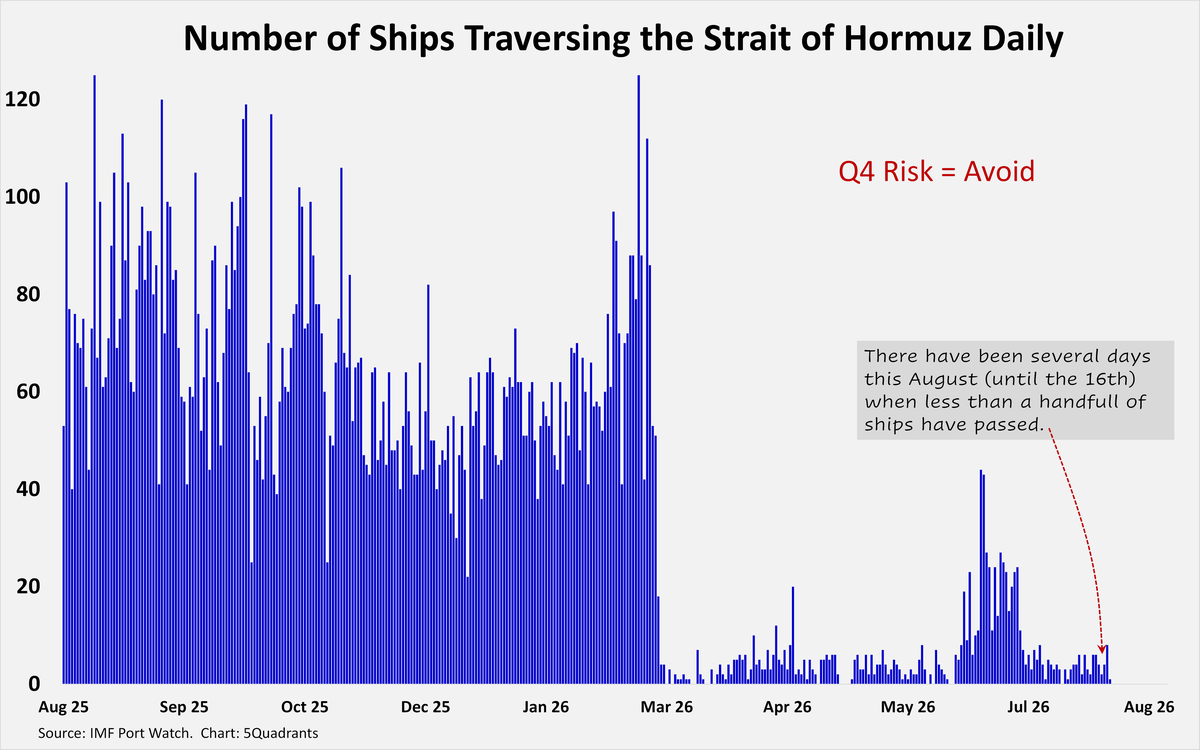 Figure 3: The number of ships passing through the Strait of Hormuz daily according to IMF Port Watch. The volume ranged from 60 to 120 per day leading up to the war and has dropped to less than a handful.
The Q4 Fat Tail Countries can sometimes engineer themselves partly out of Q4 by creating alternatives before the crisis occurs. Saudi Arabia built the first alternate route in the early 1980s in response to the Iran-Iraq war: a 1,200 km pipeline moving oil from its eastern production fields to the Red Sea port of Yanbu. They’re in talks to expand the 7 million bpd capacity by an additional 1 to 2 million bpd. The UAE (DP World) is building new east-coast port and container infrastructure that bypasses Hormuz entirely. Strategic petroleum reserve releases by Japan, China, and the US keep oil prices from spiking, and stockpiling, alternative energy, new suppliers, and demand reduction are all methods to solve this Q4 problem. Persistent Q4 exposure encourages investment in substitutes, bypasses, and buffers. One could highlight the Strait of Malacca. More oil transited through there than through the Strait of Hormuz in 2025. Malaysia and Singapore are responsible and respected maritime actors, but the Q4 risk, however small, exists. For now the only problem is petty piracy.
Other potential choke points for your Risk Radar 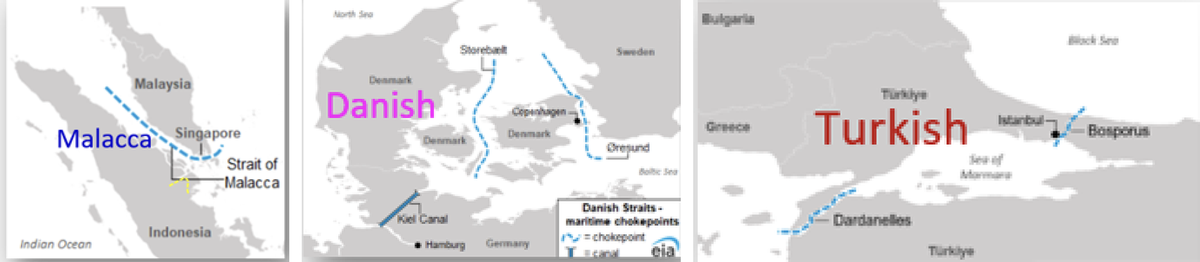
Now I need you. This project only works if we have a conversation. Have you ever piloted a ship through a narrow waterway or dealt with maritime thieves? Have you had to instantly find supply chain alternatives? Have you managed a strategic oil reserve or built alternative energy infrastructure? Let us know how you managed it and what in this Risky Tuesday newsletter you would disagree with. We’ll collect the best and share them in a future issue (or on the website risk repository), with credit. Next Tuesday, a different risk and a different quadrant. Forward this to someone who would argue with it. Dave (Claudia off this week to prep for upcoming classes)
|